



































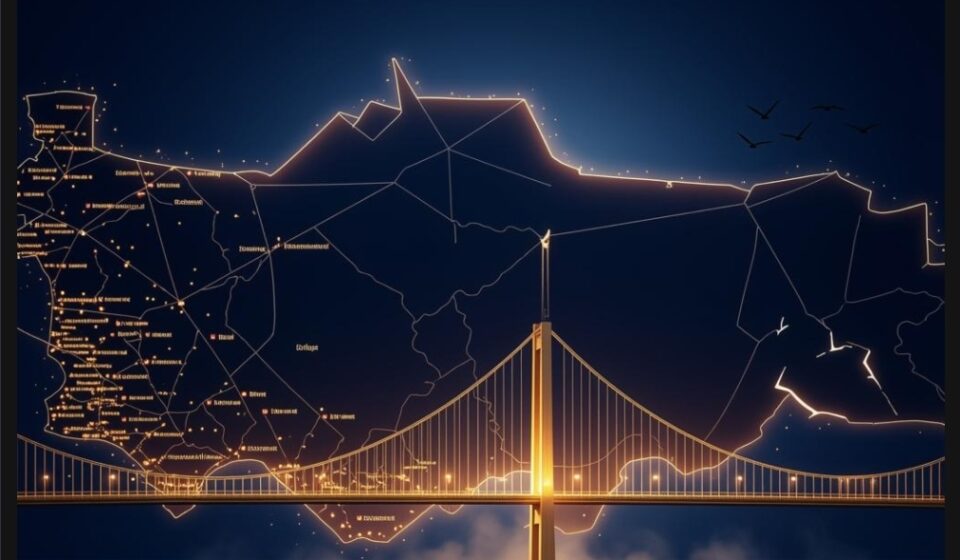

SILENT BRIEF #005
THE TURKISH HINGE: WHEN THE SANCTIONS LIFELINE BREAKS
Classification: CONFIDENTIAL // CONFLUENCE ONLY
Date: June 18, 2026
Subject: Russia-Turkey Relations — The Structural Fracture Point and Your Exposure Architecture
From: M.W. Tyler, Principal Architect
To: The Inner Orbit
THE EXECUTIVE THESIS
What consensus analysis calls a “pragmatic partnership” between Moscow and Ankara is, in geometric terms, a lopsided marriage of convenience under acute structural strain — and it is approaching its breaking point.
The relationship has shifted. It is no longer defined by compartmentalized rivalry managed through diplomatic sophistication. It is now defined by three forces converging simultaneously:
- Turkey’s perilous role as Russia’s sanctions lifeline — a function that exposes Ankara to escalating secondary sanctions while giving Moscow vital breathing room.
- Moscow’s persistent energy leverage — a trap Turkey cannot fully escape despite aggressive diversification attempts through late 2025.
- A deeply personalistic bond between Putin and Erdoğan that institutional weakness makes highly volatile — and that neither successor is guaranteed to inherit.
For Confluence members, the question is not whether this relationship is sustainable. It is not. The question is what happens to your capital, your counterparties, and your jurisdictional architecture when the hinge breaks — because the fracture will not be gradual. It will be sudden, and it will propagate through every channel that touches Turkish banking, Turkish logistics, or Turkish energy.
THE GEOMETRY: WHAT IS ACTUALLY HAPPENING
The Sanctions Evasion Engine — The New Core
Post-2022, Turkey became Russia’s premier sanctions circumvention hub. By mid-2026, this remains the relationship’s most critical — and riskiest — pillar.
Bilateral trade peaked near $52 billion in 2024. Under intense U.S. Treasury pressure through 2025, Turkey curtailed dual-use military exports but continues facilitating refined Russian oil re-exports and payment routing through its banking system.
This “parallel economy” is purely transactional. It gives Moscow vital breathing room. It exposes Ankara to escalating secondary sanctions threats. The economic tie is not a stable foundation — it is a constant diplomatic tripwire.
The Confluence read: Turkey is not Russia’s ally. Turkey is Russia’s plausible deniability. And plausible deniability has a shelf life.
Energy Asymmetry and the Leverage Trap
Russia supplied approximately 45–65% of Turkey’s gas and oil in recent years. Late 2025 marked a strategic pivot: Turkey slashed Russian crude imports, signed long-term U.S. LNG deals, and extended Russian gas contracts only on a short-term basis while quietly shelving Moscow’s proposed gas hub project.
But the diversification is incomplete — and deliberately so.
Russia injected approximately $9 billion in fresh financing for the delayed Akkuyu nuclear plant (first unit now slated for late 2026). This is not energy cooperation. It is a leverage trap. Turkey cannot easily walk away from a $9 billion commitment without absorbing a catastrophic loss. Russia knows this. The gas contracts can expire. The nuclear plant cannot.
The Confluence read: Turkey is trying to reduce dependency on Russian fossil fuels while simultaneously deepening dependency on Russian nuclear infrastructure. This is not diversification. It is dependency substitution — and the substitute is harder to exit than the original.
Montreux and the Double-Edged Sword
Turkey’s Ukraine policy is uniquely contradictory:
It arms Ukraine with Bayraktar drones — which blunted Russia’s early offensive — and offers mediation and peace-hosting. Yet, by enforcing the Montreux Convention to block NATO warships from the Black Sea, Ankara inadvertently shields Russia’s naval assets and restricts Ukraine’s maritime options.
Simultaneously, Russia has struck Turkish-linked commercial facilities in Ukraine, exposing the military friction beneath the diplomatic dialogue.
The Confluence read: This dual-hatted approach is structurally unsustainable. It buys Ankara short-term influence with both sides while eroding trust with both sides. The moment one side decides Turkey is no longer useful as a mediator, the entire architecture collapses — and with it, Turkey’s claim to strategic autonomy.
The Personalistic Foundation
This is not an institutionalized partnership. It rests almost entirely on the Putin-Erdoğan personal dynamic. The power imbalance is glaring: Russia is a more essential energy supplier to Turkey than Turkey is a market to Russia.
However — and this is the critical nuance consensus analysis misses — Turkey’s unique sanctions-workaround value gives it temporary bargaining chips that distort the apparent balance of power. Ankara is not as weak as the energy numbers suggest, because Moscow needs the sanctions corridor more than it needs the gas revenue. Remove the sanctions regime (through a Ukraine settlement or a Western policy shift), and Turkey’s leverage evaporates overnight.
Ankara actively hedges — flirting with BRICS membership while quietly realigning with the West on F-16 procurements and NATO commitments. This reveals a relationship driven by short-term utility, not shared interests.
The Confluence read: The personalistic foundation means the relationship has no institutional shock absorbers. When Putin or Erdoğan exits the stage — through death, succession, or political collapse — there is no bureaucratic architecture to sustain the cooperation. It dies with the men who built it.
Regional Friction Beneath the Surface
Beyond Syria and Libya, two undercurrents remain active:
The South Caucasus (post-Nagorno-Karabakh dynamics) where Russia leverages its role as security arbiter while Turkey pushes for regional dominance. And the Eastern Mediterranean energy rivalries, where Turkish drilling ambitions collide with Greek and Cypriot maritime claims that Russia can exploit diplomatically.
These are not dormant. They are suppressed — held in check by the personalistic relationship. When that relationship weakens, these flashpoints activate.
THE CURVE: WHERE THIS GOES NEXT
Probability Distribution — 12-Month Outlook (Q3 2026 – Q3 2027)
| Scenario | Probability | Description | Trigger |
|---|---|---|---|
| Controlled Degradation | 35% | Turkey continues partial sanctions facilitation under increased Western pressure. Relationship slowly cools without rupturing. | U.S. Treasury escalates secondary sanctions but stops short of targeting Turkish banks directly. |
| Sanctions Severance | 30% | Western pressure forces Turkey to shut down the parallel economy. Russia retaliates with energy leverage. Relationship fractures openly. | U.S. targets Turkish banks with secondary sanctions OR a Ukraine ceasefire removes the sanctions justification. |
| Erdoğan-Putin Succession Shock | 20% | Either leader exits the stage. Relationship collapses without institutional scaffolding. New leadership realigns sharply. | Health event, political crisis, or forced succession in either capital. |
| Deepened Alignment | 15% | Turkey formally joins BRICS or a non-Western security framework. Relationship deepens at cost of NATO rupture. | Erdoğan calculates that Western institutions are too fragmented to retaliate effectively. |
The Most Dangerous Scenario
The 30% scenario — Sanctions Severance — is the most dangerous for Confluence members with Turkish exposure, and it is the scenario that consensus analysis is most systematically underweighting.
Here is why: consensus reads Turkey’s hedging behavior as evidence of strategic flexibility. It is evidence of strategic fragility. Turkey is not balancing between East and West. Turkey is trapped between East and West, and the trap is tightening on both sides simultaneously.
When the sanctions pipeline severs — whether through Western enforcement or a Ukraine settlement — three cascading effects follow within 90 days:
- Turkish banking stress: Institutions that built their 2024-2026 growth on Russian payment routing face sudden volume collapse. Counterparty risk spikes.
- Russian energy retaliation: Moscow cannot punish Turkey militarily, but it can squeeze gas supplies and delay Akkuyu. Energy costs spike for Turkish industry.
- Lira depreciation acceleration: The combined banking and energy shock hits a currency already weakened by Erdoğan’s economic mismanagement. Capital flight accelerates.
The Timeline Compression
The 60-day Iran ceasefire window is not isolated from this dynamic. If the Iran framework collapses (our 20% scenario from Silent Brief #001), Russia’s strategic position strengthens — and with it, Moscow’s leverage over Ankara. If the Iran framework holds, the West gains diplomatic momentum — and with it, increased pressure on Turkey to sever the sanctions corridor.
Either outcome accelerates the Turkey-Russia fracture. The Iran window and the Turkish hinge are connected by the same geopolitical geometry. When one moves, the other moves.
THE ARCHITECTURAL RESPONSE: WHAT YOU DO NOW
1. Audit Your Turkish Counterparty Exposure
This is the immediate priority. Many Confluence members have indirect Turkish exposure they have not mapped — because it routes through entities that appear Western.
Check the following:
- Do any of your banking relationships route through Turkish correspondent banks?
- Do your logistics chains transit Turkish ports (İzmir, Mersin, Istanbul)?
- Do you hold Turkish liao-denominated assets or contracts priced in TRY?
- Do you have real estate or hospitality investments in Turkey that depend on Russian tourism flows?
- Do your energy contracts reference Turkish refining capacity (the refined Russian oil re-export hub)?
If the answer to any of these is yes — and for most principals with any Mediterranean or Eurasian exposure, the answer is yes to at least one — you have indirect Russia-Turkey sanctions exposure that is not currently priced into your risk model.
2. The Banking Risk — The Silent Channel
The most insidious exposure is banking. Turkish banks processing Russian payments are not obviously flagged in Western risk systems because Turkey is a NATO member. But NATO membership does not immunize Turkish banks from U.S. Treasury secondary sanctions — and the moment Treasury designates a Turkish bank, every Western institution clearing through it faces a compliance fire drill.
Action: Within 14 days, request from your primary banking relationship a correspondent bank mapping — a document showing every intermediary bank your transactions touch. If any Turkish institution appears in that chain, you have a contingent sanctions exposure that could freeze your transaction capability without notice.
3. The Energy Hedge
If you have industrial operations in Turkey or operations dependent on Turkish energy infrastructure:
- The Akkuyu nuclear plant is not a short-term risk. It is a long-duration hostage. Russia controls the timeline, the financing, and the operational knowledge. A sanctions severance scenario delays Akkuyu indefinitely — and Turkey replaces that capacity with… nothing. Energy costs rise. Industrial margins compress.
- Action: Price a 12-month energy cost increase of 25-40% for any Turkish-based operations. If that cost increase makes the operation unprofitable, begin jurisdictional relocation planning now.
4. The Currency Position
The Turkish lira is the canary. It is already under pressure from Erdoğan’s economic policies. A sanctions severance scenario accelerates depreciation by 30-50% within 90 days.
- If you hold TRY-denominated assets: begin reducing exposure on a schedule that does not signal panic. 30-day window.
- If you have revenue streams in TRY: hedge through CHF or USD forward contracts with counterparties that are not Turkish banks. (If you hedge TRY exposure through a Turkish bank, you are hedging against the institution you are hedging with — a contradiction that will become obvious only when it is too late.)
5. The Jurisdictional Alternative
For Confluence members currently using Turkey as a bridge jurisdiction between East and West — for banking, logistics, or residency — the fracture risk requires a replacement architecture before the fracture occurs, not after.
The Icelandic entity (addressed in Silent Brief #002) is the primary alternative for principals who need a neutral jurisdiction with no sanctions exposure and no great-power dependency. For members who need a warm-water alternative to Turkish logistics, the Omani corridor (Muscat, Salalah) is currently the least-exposed option — a port system with deep Indian Ocean access, no NATO entanglement, and active cooperation with both Western and Asian shipping partners without the sanctions profile of Turkey.
Action: If you are using Turkey as a jurisdictional bridge, commission a replacement architecture study within 30 days. The cost of the study is trivial relative to the cost of being trapped in a jurisdiction that is simultaneously losing Russian cooperation and Western tolerance.
6. The Succession Risk
The 20% scenario — a Putin or Erdoğan succession shock — is the Black Swan within this analysis. It cannot be timed. It can only be prepared for.
If Erdoğan exits (health, political crisis, or electoral surprise), his successor’s orientation is uncertain. The most likely outcome is a pivot toward the West — which sounds positive but would involve a rapid unwinding of the Russia-Turkey economic relationship that would destabilize Turkish banking before it stabilizes Turkish geopolitics.
If Putin exits, the succession dynamics in Moscow are even more opaque — but any successor’s first move would likely be to consolidate domestic control, which means pulling back from external commitments (including Akkuyu and energy cooperation with Turkey) to redirect resources inward.
Action: Ensure your Confluence exposure audit includes a succession clause — a pre-built response for what you do within 72 hours of either leader’s departure. Not because it is likely this quarter. Because the impact if it occurs is severe enough that the preparation cost is negligible relative to the unpreparedness cost.
THE REAL OWNERS CONNECTION
From Silent Brief #002 (The Map of the Real Owners), the Russia-Turkey relationship has a specific owner structure that Confluence members should understand:
- The Passive Triad (BlackRock, Vanguard, State Street): Hold significant positions in both Turkish equities (via emerging market index inclusion) and Russian energy debt (via pre-sanctions positions held in segregated accounts). They are net long stability on this relationship — but their exposure is diversified enough that a fracture does not threaten their core architecture. Your exposure is not similarly diversified.
- The Shadow Banking Complex: Several major private credit firms have underwritten Turkish industrial projects that depend on Russian energy inputs. If the energy leverage activates, these projects face restructuring. The Shadow Banks will restructure. The Turkish industrial partners will absorb the loss.
- The Logistics Giants: Maersk and CMA CGM have built their Black Sea routing through Turkish straits. A Montreux disruption (unlikely but non-trivial) would force immediate rerouting through Suez — adding 7-10 days and 20-30% cost to every shipment touching the Black Sea.
The Real Owners are prepared for this fracture. They have scenario trees. They have alternative routing. They have diversified counterparty chains.
The question for you is: do you?
THE SYNTHESIS
The Russia-Turkey relationship is not a strategic alliance. It is a mutual exploitation of necessity — one where Turkey shoulders rising geopolitical costs for diminishing returns, while Russia extracts critical economic survival value.
The “strategic ambivalence” of 2022 has curdled into structural fragility by 2026. The relationship is more likely to fracture under external pressure than deepen into genuine partnership.
For Confluence members, the architectural response is clear:
- Map your indirect Turkish exposure — banking, logistics, energy, currency.
- Begin jurisdictional replacement planning — Iceland for neutral entity, Oman for warm-water logistics.
- Hedge the currency through non-Turkish counterparties.
- Build the succession contingency — the 72-hour response protocol.
- Monitor the Iran 60-day window — because when that hinge moves, this hinge moves.
The geometry is visible. The curve is clear. The fracture is coming. The question is whether you are positioned for it — or exposed to it.
“Fragmented chaos is liquid tranquility to another.”
To the center, the Turkey-Russia relationship looks stable. To the ellipse, it is a hinge under load — and hinges under load either hold or break. There is no middle state.
Prepare for the break. If it holds, you lose nothing. If it fractures, you lose everything you didn’t protect.
Direct questions and bespoke exposure audits to the Silent Channel within 72 hours.
M.W. Tyler Principal Architect Chic 10 / Pocket Computer Networks
Geopolitical insights that are disruptors and system changers are not investment advice.
Chic 10 · Pocket Computer Networks, Inc. Hosted in Iceland. Operating Globally. chic10.com · @economicsonx · @mwtyler
