






































The History of Zen
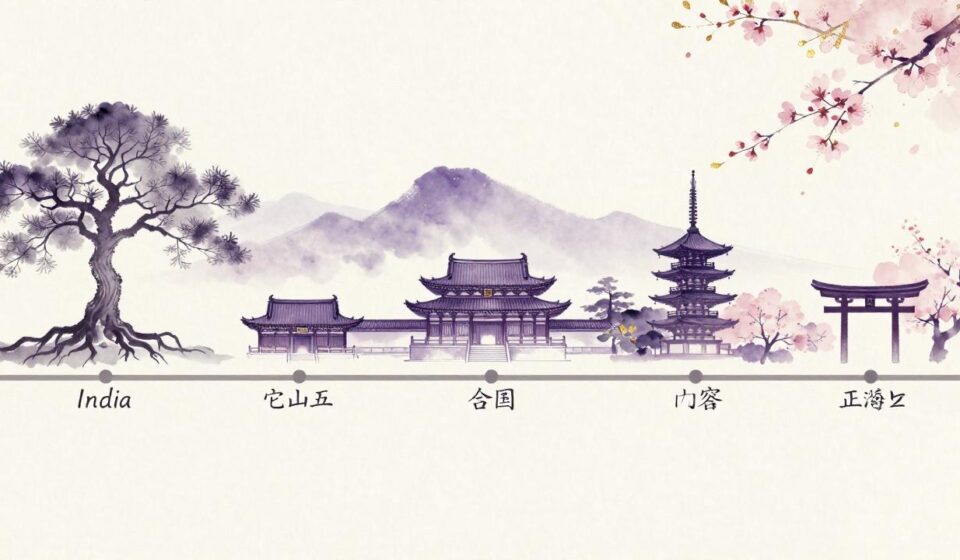
Zen is a school of Mahayana Buddhism that emphasizes direct experiential realization—particularly through meditation (zazen)—rather than reliance on scripture or ritual alone. Its history spans roughly 1,500 years and traces a path from India through China to Japan and, eventually, the world.
Origins in India
Zen traces its spiritual lineage to the historical Buddha, Siddhartha Gautama (c. 5th–6th century BCE), who is said to have achieved awakening beneath the Bodhi tree. The word Zen derives from the Sanskrit dhyāna, meaning “meditation” or “absorption.” While Indian Buddhism had rich meditative traditions, the specific formulation we recognize as Zen did not take shape in India. Rather, Indian Buddhism provided the philosophical and contemplative raw materials.
The Chinese Crucible: Chan Buddhism
Buddhism arrived in China around the 1st–2nd century CE via the Silk Road. Over centuries, it interacted deeply with native Chinese philosophy—particularly Daoism—and out of this synthesis emerged Chan (禪), the Chinese precursor to Zen.
The legendary founding figure of Chan is Bodhidharma, an Indian (or possibly Central Asian) monk who is traditionally said to have traveled to China around 520 CE. He is credited with bringing the emphasis on wall-gazing meditation and the famous principle of “a special transmission outside the scriptures, not founded on words or letters.”
By the Tang Dynasty (618–907 CE), Chan had crystallized into a distinctive school. Two principal lineages emerged:
- The Linji (Rinzai) school, emphasizing sudden enlightenment and the use of gong’an (public cases, known later in Japanese as kōan).
- The Caodong (Soto) school, emphasizing gradual practice and “silent illumination” (mozhao).
Key figures of this golden age include Huineng (638–713), the Sixth Patriarch, whose Platform Sutra articulated the radical idea that enlightenment is intrinsic—nothing to be gained or achieved. Linji Yixuan (d. 866) and Dongshan Liangjie (807–869) lent their names to the two major schools.
Transmission to Japan
Chan reached Japan in the late 12th–13th centuries, carried primarily by two monks:
- Eisai (1141–1215) traveled to China, studied Linji teachings, and returned to found the Rinzai school in Japan.
- Dōgen (1200–1253) traveled to China, studied Caodong teachings, and returned to found the Soto school. His masterwork, the Shōbōgenzō (“Treasury of the True Dharma Eye”), remains one of the most profound works in all of Buddhist literature.
In Japan, the term Chan was rendered in Japanese as Zen (禅). Zen flourished especially during the Kamakura (1185–1333) and Muromachi (1336–1573) periods, gaining patronage from the samurai class. It profoundly influenced Japanese culture—tea ceremony, ink painting (sumi-e), garden design, poetry (especially haiku), and the martial arts.
A later development was the emergence of Ōbaku Zen in the 17th century, brought by Chinese monk Ingen Ryūki (1592–1673), blending elements of Zen and Pure Land Buddhism.
The Modern Era
Zen’s encounter with the West began in earnest in the late 19th–early 20th centuries. Several factors drove this:
- Japanese scholars and monks presented Zen at the 1893 World Parliament of Religions in Chicago.
- D.T. Suzuki (1870–1966) published extensively in English, popularizing Zen to Western audiences, though his framing has been criticized for emphasizing a decontextualized, romanticized version.
- After World War II, the Allied occupation of Japan sparked broader Western interest in Japanese culture, and Zen masters like Shunryu Suzuki (1904–1971) and Robert Aitken helped establish practice centers in America.
Zen spread globally, adapting to local cultures. In the West, it intersected with Beat literature (Jack Kerouac, Gary Snyder, Allen Ginsberg), psychotherapy, and countercultural movements. Schools like the San Francisco Zen Center, the Rochester Zen Center, and Plum Village (founded by Vietnamese Thích Nhất Hạnh, in the Thien tradition—Vietnamese Zen) became influential.
Critiques and Complexities
The history of Zen is not without controversy. Modern scholarship has questioned:
- The historical veracity of lineage accounts—many traditional “histories” were retroactively constructed to legitimize certain schools.
- The role of Zen nationalism in early 20th-century Japan, where some institutional Zen figures supported militarism.
- Western appropriations that sometimes strip Zen of its ethical, devotional, and communal dimensions, reducing it to a technique for stress reduction.
These tensions reflect the ongoing negotiation between Zen as a living religious tradition and Zen as a cultural export.
Key Timeline Summary
| Period | Development |
|---|---|
| c. 5th–6th c. BCE | The Buddha teaches dhyāna in India |
| c. 520 CE | Bodhidharma traditionally arrives in China |
| 618–907 (Tang Dynasty) | Golden age of Chan; Huineng, Linji, Dongshan |
| Late 12th–13th c. | Eisai and Dōgen transmit Rinzai and Soto to Japan |
| 1336–1573 (Muromachi) | Zen deeply shapes Japanese arts and culture |
| 1654 | Ōbaku school introduced to Japan |
| 1893 | Zen presented at the World Parliament of Religions |
| Mid–20th c. | D.T. Suzuki and postwar emigration spread Zen globally |
| 1950s–1970s | Zen takes root in Western practice centers |
Zen’s history is ultimately a story of adaptation: a contemplative impulse originating in India, shaped by Chinese philosophy, refined in Japanese monastic culture, and eventually scattered across the globe—continuously transforming while insisting on the irreducible, wordless heart of its teaching.
