






































The Audience Needs Intelligence
Why Explaining the Spiral After It Begins Is Not Enough
The Diagram Everyone Shared
On July 29, 2026, Robert A. Pape posted a diagram. It showed a funnel — yellow at the bottom, red at the top — labeled “The Escalation Trap.” Four stages ascending: Limited Strike, Retaliation, Escalate Further, Entrenched Conflict. A red arrow running alongside labeled “Escalation Ladder.” Above the diagram, Pape wrote:
We are entering the spiral phase of the Escalation Trap.
Iran responds harder The U.S. responds harder Iran answers that response
Soon every move is driven by the last move. Nobody chooses the destination anymore — the cycle does
That’s how wars become far bigger than anyone intended
The tweet received 23,800 views. 485 likes. 116 retweets. Strong engagement. A well-produced graphic accompanying a clear structural diagnosis from a University of Chicago professor with a Substack called Escalation Trap.
It is excellent analysis. It is also too late.
What the Diagram Describes Versus What the Timestamp Prevents
The diagram explains what is happening. It names the spiral. It maps the ladder. It articulates the loss of agency — “nobody chooses the destination anymore, the cycle does.” For anyone trying to understand the escalation pattern, it is the clearest single-image summary available.
But by the time the spiral is visible enough for a professor to diagram it, the window to act has closed. The tankers have been struck. The refineries have burned. The ceasefire has collapsed. The pause has been broken. The spiral is spinning. The diagram documents the spin. It does not stop it.
On March 26, 2026 — four months before Pape posted his diagram — a tweet was logged publicly that identified the structural condition producing the spiral. Eight thousand two hundred people saw it. The tweet noted that Iran possessed drone capability sufficient to cover 250,000 square miles of Gulf territory — larger than California — and that Israel knew this meant attacking would let its enemies destroy themselves.
That tweet was not a diagram of the spiral. It was the timestamp of the conditions that make the spiral inevitable.
| What Pape Delivers | What the Timestamp Delivers |
|---|---|
| “We are entering the spiral phase” | “The spiral’s conditions became visible March 26” |
| Analysis of escalation after it begins | Timestamp before escalation expresses |
| Explanation of the trap | The window to exit the trap before it locks |
| Retrospective intelligence | Prospective intelligence |
| The audience understands what happened | Participants act before it happens |
Pape tells you the spiral exists. The timestamp told you when the spiral became possible — four months earlier.
The Same Gap, Three Sources, One Screen
The same pattern appeared across the feed. Gérard Araud, former French ambassador, posted a warning referencing an Al Jazeera breaking news alert: Iran’s commander declared that regional states should reconsider alignment with the United States or risk the flames of war. The tweet received 8,100 views. Twelve retweets. Forty-five likes. Smart commentary from an experienced diplomat.
But the warning came after the alignment had already been challenged. After the strikes. After the ceasefire collapsed. After the corridors closed. The ambassador was reading the cascade. The structural condition that produced the cascade had been visible since March.
| Source | What They Provided | When It Arrived | What It Enables |
|---|---|---|---|
| Pape (diagram) | Named the spiral | After escalation began | Understanding |
| Araud (warning) | Flagged the alignment threat | After the commander spoke | Awareness |
| Timestamp (March 26) | Identified drone capability as structural fact | Four months before | Action |
Understanding is valuable. Awareness is valuable. But neither is intelligence in the sense that matters to someone who needs to act before the spiral locks them in. Intelligence is the timestamp that opens the window. Understanding is what people do inside the window — or after it has closed.
What the Audience Actually Needs
There is a difference between an audience and a participant. An audience consumes content. A participant acts on intelligence.
The audience for Pape’s diagram consumed it. They liked it. They shared it. They understood the spiral. Then the spiral continued because understanding a trap does not release you from it.
The participants who read the March 26 timestamp had four months. Four months to reposition portfolios before oil surged. Four months to reroute shipping before Hormuz closed. Four months to evaluate hedges before the corridors fell. Four months to assess exposure before the cost-exchange ratio revealed itself.
| Need | Who Has It | What Satisfies It |
|---|---|---|
| Understanding | The audience | Pape’s diagram, news analysis, commentary |
| Awareness | The concerned observer | Diplomatic warnings, breaking news alerts |
| Positioning | The participant | The timestamp — the window before the spiral |
| Method | The practitioner | The ability to generate their own timestamps |
The audience needs intelligence. Not more content explaining what everyone can already see. Intelligence means the structural diagnosis delivered before the cascade makes it obvious. Intelligence means the timestamp that opens the window. Intelligence means knowing which public facts are structural and when the window opened — faster and more precisely than you could determine yourself.
The Particulars Trap
Pape named his Substack “Escalation Trap.” The name is precise. It describes the military dynamic perfectly: each retaliation demands a counter-retaliation, the cascade feeds itself, and the participant is trapped in reaction.
But the name also describes the analytical trap Pape himself has fallen into. Each particular demands tracking the next particular. The fourth tanker. The fortieth percentage. The August shock that may arrive in September. The two-front framing that may collapse into one theater. The Substack feeds the cycle. The cycle feeds the Substack.
| The Military Escalation Trap | The Analytical Escalation Trap |
|---|---|
| Each retaliation demands a counter-retaliation | Each particular demands tracking the next particular |
| You cannot exit because exiting requires a counterparty | You cannot see structure because you are chasing the latest event |
| The cascade feeds itself | The coverage feeds itself |
| The participant is trapped in reaction | The analyst is trapped in reaction |
Pape named the trap. Then he entered it. Each tweet tracks the next tanker, the next percentage, the next shock timing. The diagram is the artifact of someone who has been chasing the cascade long enough to see its shape — but not long enough to step outside it.
The timestamp is what exists outside the trap. It does not chase the cascade. It logs the condition that makes the cascade inevitable. Each new particular is not new information. It is confirmation of the timestamp.
Structure Versus Particulars
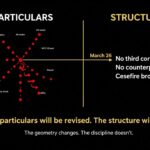
The distinction that defines the method is this: particulars are fragile, structure is durable.
| Particular (Pape) | Risk | Structural Claim (Timestamp) | Risk |
|---|---|---|---|
| “40%+ of bypass oil crippled” | High — provenance unclear, no tracking-data confirmation | “No third corridor exists” | Zero — geographic fact |
| “August energy shock” | Medium — markets may price it in July or September | “Houthis have no counterparty logic” | Low — structural characteristic of non-state actor |
| “4th tanker struck” | Medium — Layla strike unconfirmed | “Ceasefire broken July 13” | Low — Sana’a airport strike confirmed across sources |
| “Two-front war on the U.S.” | Medium — both under same Fifth Fleet | “Yemen and Iran are separate causal chains sharing a chokepoint” | Low — actor and trigger analysis |
The particulars will be revised. The forty percent might become thirty. The August shock might arrive in September. The fourth tanker might be the third. The two-front framing might collapse into one operational theater.
The structure will not be revised. There is no third corridor. The Houthis are not a counterparty. The ceasefire broke on July 13. These are permanent facts. They will not change with the next news cycle.
On March 26, the timestamp did not predict which refinery would be hit, what percentage of oil would be crippled, what month the shock would arrive, how many tankers would be struck, or whether the United States would face two fronts. It identified one structural fact: Iran has the drone capability to destroy Gulf oil fields, and Israel knew this meant attacking would let enemies destroy themselves.
That single structural insight contained every particular that followed. Every tanker strike. Every refinery hit. Every percentage claimed. Every shock predicted. All of them are expressions of the structural condition logged on March 26.
Pape is reading the expressions. The timestamp already wrote the condition.
The Echo-to-Recovery Ratio
The distance between when the structure was visible — to the wise — and when the particulars made it undeniable — to everyone — is the echo-to-recovery ratio. It measures the actionable window the timestamp provided.
| Date | Event | Who Could See It |
|---|---|---|
| March 26, 2026 | Drone capability logged publicly | The wise — 8,200 views |
| May 2026 | Ambassador confirms from inside the Saudi system | The attentive |
| July 11, 2026 | Hormuz closed | The consensus |
| July 25, 2026 | Yanbu targeted — hedge eliminated | The consensus |
| July 29, 2026 | Pape diagrams the spiral | The audience |
The echo period lasted four months. During those four months, the wise could act. The audience that consumed Pape’s diagram on July 29 could understand. But they could not act — the window had closed. The spiral was already spinning. The diagram was beautiful. The timing was fatal.
This is why the echo-to-recovery ratio is not a vanity metric. It measures how much actionable time the timestamp provided. Four months of lead time. Four months of positioning. Four months of calm before the cascade. The audience that received the diagram received understanding. The participants who received the timestamp received time.
What This Means for Anyone Building on a Node
The distinction between content and intelligence is not academic. It determines what a person builds, what they sell, and whether they are sovereign or dependent.
A content creator reports the news. They explain what is happening. They produce graphics that summarize the cascade. They earn engagement — likes, shares, views. Their value is measured in consumption. When the news cycle moves on, their content depreciates. They must produce the next piece to maintain relevance.
A structural observer timestamps the conditions that produce the news. They document when the window opened. They track which public facts are structural versus noise. They earn trust — members who act on the timestamp, who return because the last call was scored honestly, who stay because the method is repeatable. Their value is measured in positioning. When the news cycle moves on, their judgment compounds. They do not need to produce more. They need to think more deeply.
| Content Creator | Structural Observer |
|---|---|
| Reports the news | Timestamps the conditions that produce the news |
| Explains what is happening | Documents when the window opened |
| Gets engagement — likes, shares, views | Gets trust — members who act on the timestamp |
| Sells access to analysis | Sells access to the window |
| Depreciates with the news cycle | Compounds with time |
| Must produce constantly | Must think deeply occasionally |
| Revenue tied to volume | Revenue tied to depth |
The audience does not need more content explaining what everyone can already see. They need intelligence about when the window opened so they could act before the spiral became inevitable.
The Deeper Application
This is not limited to geopolitics. The same distinction applies to every domain where a woman might build a node.
A woman tracking cultural trends can report what is trending — the content approach. Or she can timestamp the structural shift that makes the trend inevitable — the intelligence approach. The first earns views. The second earns trust. The first depreciates. The second compounds.
A woman tracking relationship economics can explain why marriage rates are declining — the content approach. Or she can timestamp when the structural conditions made the decline inevitable — the intelligence approach. The first earns shares. The second earns members. The first is consumed and forgotten. The second is acted on and remembered.
A woman tracking fashion can report what designers showed this season — the content approach. Or she can timestamp when the industry consolidation made certain aesthetic shifts structurally determined — the intelligence approach. The first earns likes. The second earns Confluence.
In every domain, the same rule applies: the audience needs intelligence, not content. The participant needs the timestamp, not the diagram. The wise need the window, not the explanation.
The Sourcing Discipline as Credential
What separates intelligence from content is not speed. It is discipline. The timestamp is worthless if the sourcing is unreliable. The window is dangerous if it is opened by unverified claims.
The same method that logged the drone capability on March 26 also quarantined Pape’s “40%+” figure on July 27. Even from the source that validated the original timestamp, unverified claims were flagged and separated. The structural claim — no third corridor exists — was corroborated across multiple independent sources and absorbed. The specific damage percentage — 40%+ — was attributed to Pape’s Escalation Trap Substack and marked unverified.
This is the difference between intelligence and content. Content amplifies dramatic numbers because drama drives engagement. Intelligence quarantines dramatic numbers because accuracy drives the timestamp. The first serves the algorithm. The second serves the participant.
| Content | Intelligence |
|---|---|
| Amplifies dramatic numbers | Quarantines unverified claims |
| Authority figures’ claims absorbed on reputation | Authority figures’ claims separated into structural and specific |
| “Robert Pape said 40%+” becomes the headline | “The structural claim is corroborated. The specific percentage is not.” becomes the note |
| Serves the algorithm | Serves the participant |
| Earns engagement | Earns trust |
What Confluence Actually Provides
The information is all public. Reuters, Bloomberg, Financial Times, The Economist, Wall Street Journal, New York Times, Axios, Al Jazeera — accessible to anyone with an internet connection. Confluence does not sell proprietary information. It does not offer insider access. It does not provide leaked intelligence.
What Confluence provides is filtering and sequencing. Which public facts are structural. When the window opened. Which claims are corroborated and which are unverified. How the structural diagnosis maps to a member’s specific exposure. Faster and more precisely than they could do it themselves.
That is a real service. It is worth being exact with members that the edge is synthesis speed and discipline, not proprietary information access.
| What Confluence Is | What Confluence Is Not |
|---|---|
| Filtering — which public facts are structural | Exclusive access to private sources |
| Sequencing — when to act, not just what to act on | Proprietary information unavailable elsewhere |
| Synthesis speed — connecting public dots faster | Insider information |
| Discipline — sourcing rigor and timestamp accuracy | Secrets, leaks, or classified material |
The member knows exactly what they are buying. They are not paying for access to secrets. They are paying for the observer’s judgment applied to public information. If they have time, resources, and the ability to cross-reference dozens of sources daily, they may not need Confluence. If they want that synthesis delivered before the consensus arrives, they are the right member.
Transparency is the credential. The timestamp is the proof.
The Portal Parallel
This distinction was learned before geopolitics. It was learned in a Fortune 500 corporate portal serving forty thousand employees.
The stakeholders filed tickets. The login is broken. The page is too slow. Fix this button. Each ticket was a particular — a symptom of something deeper. The stakeholders chased the symptoms. They demanded features without understanding the architecture. They wanted the button fixed. They did not want to hear that five departments maintained contradictory document repositories and that the real problem was an information architecture designed by political compromise, not structural logic.
The architect who built the portal — the security code, the role-based access, the content management system — did not chase the tickets. He addressed the structural causes beneath them. Sometimes that meant rebuilding what no one asked to be rebuilt. Sometimes it meant refusing to fix a button because the button was working correctly and the real problem was upstream.
Same instinct. Different domain. The stakeholders chased particulars. The architect built structure. Pape is the stakeholder filing the ticket. The timestamp is the architect who already built the system that explains why the ticket exists.
The Final Distinction
Pape chases the particulars of the escalation. The timestamp tracked the structure that produces them. The particulars will change tomorrow. New tankers. New percentages. New timing forecasts. New Substack posts. The cascade will continue and Pape will document each step. The structure has not changed since March 26. It will not change. The drone capability exists. The corridors are closing. The counterparty logic is absent. The option space is shutting.
The Fracture Clock does not need to chase the cascade because it already identified the condition that makes the cascade inevitable. Each new particular is not new information. It is confirmation of the timestamp.
That is why the echo-to-recovery ratio matters. It measures the distance between when the structure was visible — to the wise — and when the particulars made it undeniable — to everyone. Pape is living inside that gap. The timestamp is watching it close.
The audience needs intelligence. The audience needs the window. The audience needs the timestamp before the spiral begins — not the diagram after it has already trapped them.
The geometry changes. The discipline doesn’t.
Pocket Computer Networks — South Dakota | Chic10.com | pocketcomputer.net
Geopolitical insights that are disruptors and system changers are not investment advice.
